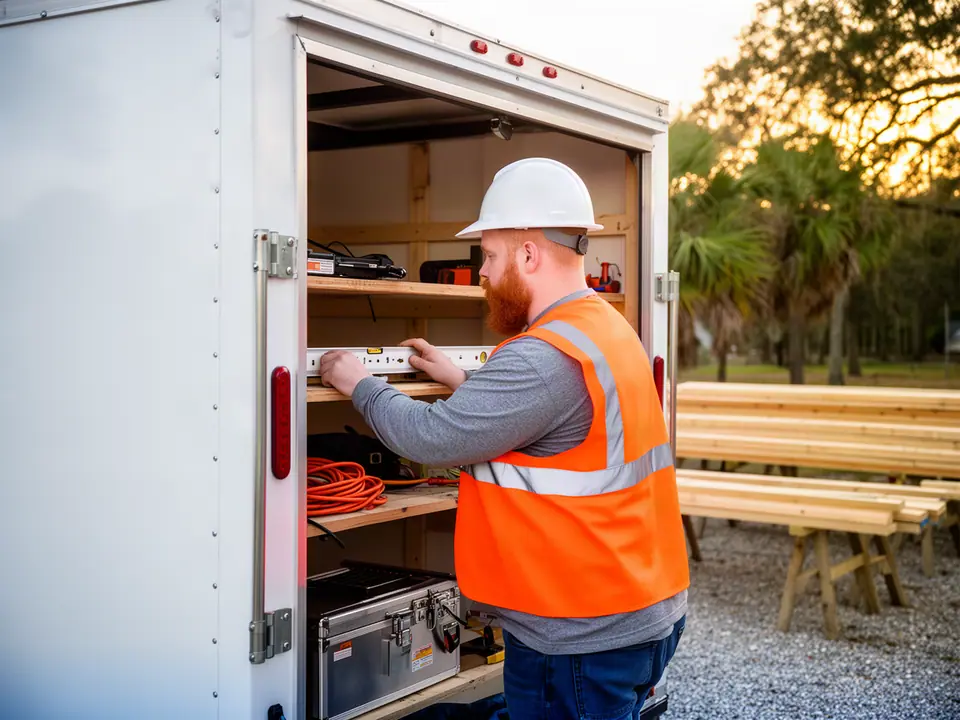
A Gulfport, MS home builder can cover materials and crews before a construction draw clears with a revolving line of credit or a working capital loan, repaid from the draw, while skid steers and trailers go on equipment loans of their own. Rowancroft Lending sends the builder's request to funding partners, who review it and decide.
An article from Rowancroft Lending in Gulfport, Mississippi on the gap between a builder's costs and its construction draws, with Harrison County permit and Census figures and invented examples.
Materials and crews before a draw clears in Gulfport, MS
A construction loan pays a builder in draws: a stage is finished, the bank's inspector checks it, and the draw is released. Between the end of a stage and the money, the builder has already paid the framing crew, ordered the trusses and windows and run up the supplier account for the next stage. On one house that gap is a few weeks; across several houses at different stages it never closes.
Illustration only, invented figures: a builder's crew costs $9,600 a week, and the framing draw arrives 24 days after the stage is done. Depending on the payday, 3 or 4 weekly payrolls fall inside that wait. With a $38,000 framing package due on the supplier account in the same window, $66,800 to $76,400 goes out before the draw comes in.
A builder can shrink that gap from its own side, too: book the draw inspection the day a stage is finished, keep lien waivers ready for each draw, and agree supplier terms that run past the draw wait. Whatever gap is left after that is the figure a funding request should name.
Building activity in the county gives that gap real scale. Harrison County’s 2025 building-permit total is 2,294 new privately owned housing units, according to the Census Building Permits Survey (county estimate). The home builders based here with paid staff are mostly small: 39 of the 54 residential building construction establishments, or 72.2%, had fewer than five employees in 2023 (County Business Patterns, NAICS 2361).
Skid steers, trailers and lifts on equipment loans
Machines that move from lot to lot, such as a skid steer, a compact track loader, an equipment trailer or a rough-terrain forklift, have serial numbers and a strong resale market, so a partner can lend against them. Putting them on their own equipment loan leaves the whole credit line for materials and payroll.
Illustration only, invented figures: a $58,000 skid steer and a $9,500 trailer, $67,500 together, financed over 60 months at an annual rate of 9.25%, cost $1,409.39 a month, or $84,563.40 over the term. If the same skid steer rents for an invented $650 a week, the monthly payment equals about 2.2 weeks of rental. On these figures, a builder who needs the machine more than that each month pays less by financing it, before fuel, insurance and upkeep.
Rentals still make sense for a machine needed on one job. The equipment financing page covers new and used machines and leases.
A revolving line for Harrison County, MS job costs
A line of credit matches the way a builder's cash moves: draw for the lumber package, repay when the draw clears, draw again for the next house. Interest accrues on the amount drawn for as long as that balance is outstanding. A partner sets the limit from the builder's revenue, contracts and history with draws, and may review the line each year.
Illustration only, invented figures: $42,000 drawn for 30 days at an annual rate of 12.5% costs about $431.51 in interest ($42,000 times 12.5%, times 30 of 365 days). A one-time working capital loan of $60,000 over nine months at an annual rate of 13.5% costs $7,047.26 a month whether the money is needed that month or not, with $3,425.34 of interest over the term.
A line suits a builder with houses going up in rotation; a term working capital loan suits a single known gap, such as the start of a larger contract. The line of credit page and working capital loans explain each in more detail.
Contracts and receivables a lender reads
A builder's request is read through its contracts. The file can include:
- Signed construction or purchase contracts for the houses under way.
- The construction lender's draw schedule and the latest draw inspection reports.
- Supplier account statements and lien waivers for paid stages.
- A work-in-progress schedule showing each house, its stage and the draws still to come.
- The state residential builder license if the work requires one, and proof of insurance.
- Two years of business tax returns and recent business bank statements.
Builders without staff are counted separately: Nonemployer Statistics found 720 residential building construction businesses without paid employees in Harrison County, MS in 2024. A builder without staff can still ask about a line for materials. On the employer side, ZIP 39501 held 5 residential building establishments in 2023 (ZIP Code Business Patterns, a ZIP figure).
Contractor types beyond home building are on the construction page. To start, call (228) 261-9974 or use the request form; the contracts and draw reports come later. See also the other articles.
By Rowancroft Lending · Updated